
Table of Contents
Your complete guide to the most magical India winter destinations for 2026 — and why this might be the year the whole world finally discovers what Indians have always known
By Holiday Dost | July 2026 | Destinations > India > Winter Travel
Let me tell you something I genuinely believe, as someone who has been watching the world of travel very closely this year.
The Middle East is in turmoil. Over 23,000 flights have been cancelled across Gulf airspace. The World Travel & Tourism Council estimates the region is haemorrhaging $600 million every single day in lost visitor spending. Travellers from Europe, North America, and East Asia — people who had their 2026 itineraries mapped out six months ago — are scrambling. Plans to Dubai? On pause. A layover through Doha? Rerouted. The seamless global connectivity that modern travel had taken for granted has, for the first time in years, been genuinely, significantly disrupted.
And into that anxious silence, a country of 1.4 billion people, of 28 states and 8 union territories, of the Himalayas and the backwaters, of the Thar Desert and the Andaman Islands, of ancient ghats and colonial hill stations, is quietly raising its hand.
That country is India. And it is absolutely ready for you this winter.
This is not a PR piece. This is me, as a traveler, telling you what I can see with my own eyes: India in 2026 is not just the safest major winter destination in this part of the world. It is one of the most achingly beautiful, culturally rich, and genuinely exciting places on the planet to be right now. And the world — slowly, finally — is starting to realise it.
Let me take you through the winter destinations. All of them. The iconic ones and the hidden ones. The ones that will make you cry with beauty and the ones that will make you cry with cold. And I’ll explain, along the way, why India in winter is not a consolation prize. It is the first prize.
First, Let’s Talk About What Is Actually Happening in the World
You deserve the honest version of the global picture before I start waxing poetic about snow-capped peaks.
The escalation of the US–Iran conflict in 2026 triggered widespread closures of key Middle Eastern airspace — including Bahrain, Kuwait, Qatar and the UAE — forcing major global airlines to cancel or reroute flights that normally cross the Gulf. The Gulf states — Dubai, Doha, Abu Dhabi — handle approximately 14 percent of the world’s transit traffic. They are the great connectors, the bridges between East and West. When those bridges wobble, the whole world feels it.
Airlines have introduced fuel surcharges to offset rising costs, while travel companies anticipate that overall travel expenses could increase by 20–30 percent in the near term. For international travelers who had planned holidays in this region, the situation is genuinely disorienting.
But here is what matters for our purposes: as geopolitical tensions continue to disrupt travel in the Middle East, Asia and domestic destinations are becoming more attractive options for travelers seeking safety, affordability, and ease of access. India can attract travelers avoiding unstable regions — there is growth in domestic tourism, MICE, and destination weddings, and a clear opportunity for India to position itself as a safe travel destination.
That opportunity is not theoretical. It is happening right now. And the travellers paying attention are already booking.

The Himalayan North: Where Winter Means Magic
🏔️ Gulmarg, Kashmir — The Best Ski Resort You’ve Never Tried
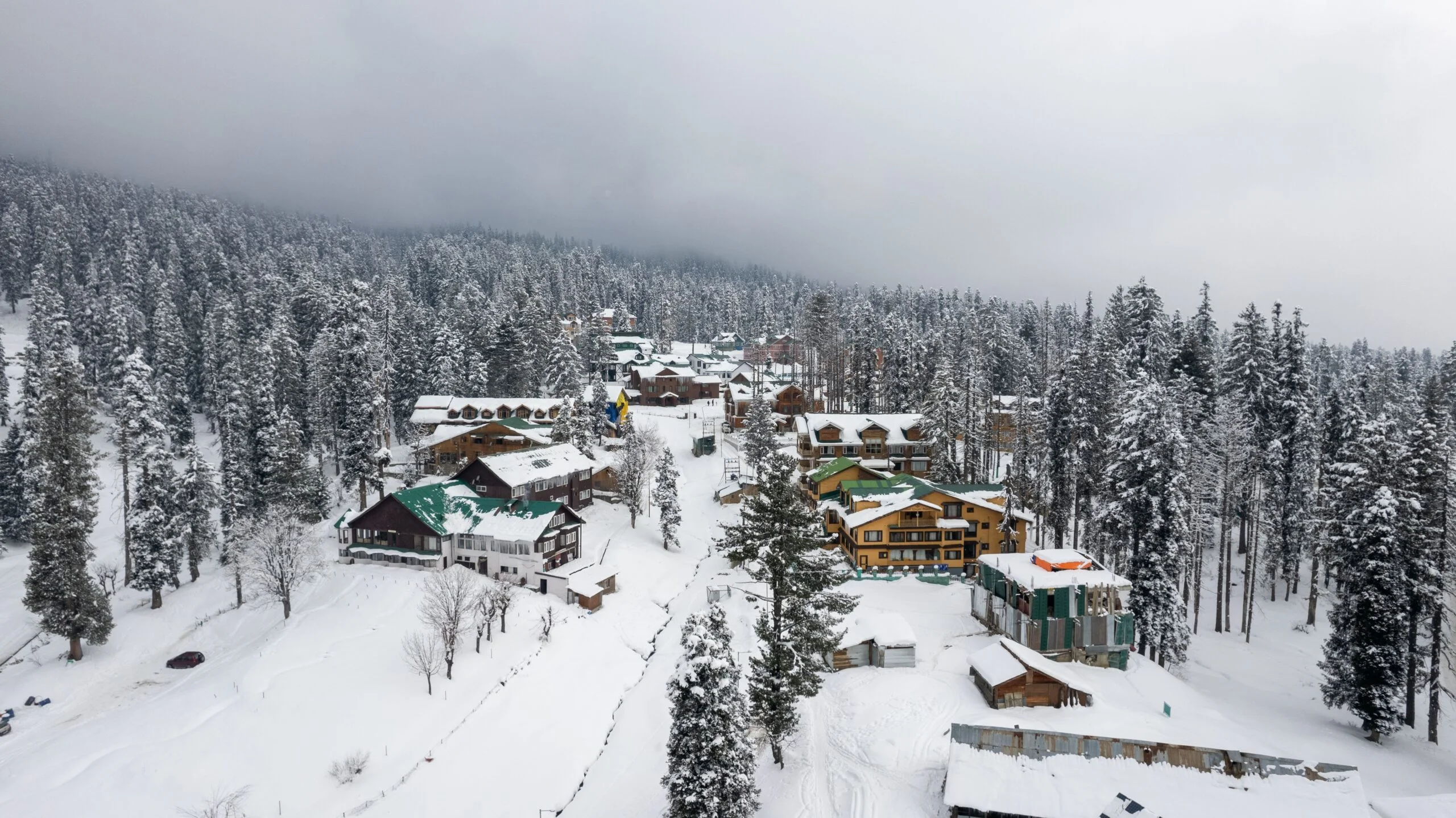
I want you to imagine this: a bowl-shaped meadow at 8,700 feet, ringed entirely by snow-covered mountains, so silent that the only sound you can hear is the creak of the Gondola cable car rising above you, and the distant laughter of children sledding on a slope that runs all the way to the treeline.
That is Gulmarg in December. And it is utterly, unreasonably beautiful.
Gulmarg reigns supreme in Jammu & Kashmir as one of Asia’s best ski destinations. During winter, the entire valley glistens under thick snow. The Gulmarg Gondola, one of the highest cable cars in the world, takes you up to 4,000 meters for a jaw-dropping panorama of white peaks and deep valleys. For non-skiers, simply wandering through Gulmarg’s frozen meadows — surrounded by pines so heavy with snow they bend like old men — is worth the journey entirely.
Gulmarg hosted India’s first National Winter Games, and it remains the country’s premier skiing destination. Ski courses are available for beginners. Equipment rental is affordable. And after a day on the slopes, you will find the warmest, most golden cup of Kashmiri Kahwa — saffron-infused tea — waiting for you at any guesthouse along the road.
Best time: December to March | How to reach: Fly into Srinagar (50 km away) | Don’t miss: Sunrise from the Gondola Phase 2 viewpoint

The Chadar Trek, Ladakh — Walking on a Frozen River
If Gulmarg is beautiful, the Chadar Trek is something else entirely. It is one of those experiences that people come back from changed.
Ladakh as a winter destination redefines adventure. Though temperatures can plummet below –20°C, its surreal beauty makes it one of the most extraordinary places to visit in winter in India. One of the region’s most iconic winter experiences is the Chadar Trek, where trekkers walk over the frozen Zanskar River — an exhilarating journey through towering gorges and icy canyons.
The “chadar” — Urdu for blanket — refers to the frozen sheet of river that forms every January on the Zanskar. You walk on it. Across gorges. Through shadows cast by walls of ice. You sleep in caves. You eat rice and dal heated over tiny fires while the temperature outside falls below what most thermometers are designed to measure. And in the mornings, the ice glows blue-green, and the canyon walls rise above you in perfect silence.
The town of Leh, though quieter in winter, still radiates a unique charm with its prayer flags fluttering in the icy wind, the Leh Palace overlooking the valley, and the sound of monks chanting in ancient monasteries like Thiksey and Hemis.
Best time: January–February (the trek window is very specific — book 2 months ahead) | Fitness required: High | HolidayDost note: This is an experience you will talk about for the rest of your life.

Auli, Uttarakhand — Skiing with a Nanda Devi View
If Kashmir is India’s most famous ski destination, Auli is its most spectacular one. Perched at over 2,800 metres in the Garhwal Himalayas, Auli is often called the Skiing Capital of India. This pristine hill station offers sweeping views of the Nanda Devi, Kamet, and Mana Parvat peaks. For beginners, the Auli Ski Resort offers training courses and guided runs, while adventure enthusiasts can take the Auli Ropeway — one of Asia’s longest — for breathtaking aerial views.
What makes Auli different from Gulmarg is the intimacy. This is a small place. There are no big crowds, no tourist hordes. Just pine forests covered in powder, a ropeway that glides silently through mist, and a panorama that puts the Alps on notice.
Best time: January–March | How to reach: Fly to Dehradun (Jolly Grant Airport), then drive or take the ropeway from Joshimath
🏔️ Manali, Himachal Pradesh — Where Mountains Meet Celebration
Manali, as a winter destination, is a completely different creature from its summer self. Solang Valley becomes a popular spot for skiing and paragliding. The old town cafes keep you snug near crackling fires. Snow-covered, Hadimba Temple feels like it’s from a fairy tale. Vashisht’s hot springs warm you right up when it’s cold outside.
Manali at New Year’s Eve is one of the great underrated party experiences in India — bonfires by the Beas River, live music in snow-dusted camps, fireworks over the Rohtang snowfields. And by 7am on January 1st, if you drive up to Gulaba, you will stand in fresh snow and silence and wonder why you ever considered going anywhere else.
Best time: Late December–February | Don’t miss: Solang Valley snow activities + Old Manali café culture
The Spiritual North: Where India Goes Deep
🪔 Varanasi — The Winter Fog Makes It Even More Extraordinary
People often ask me: when is the best time to visit Varanasi? And I always say winter. Without hesitation.
In December and January, a thick river fog descends on the Ganges at dawn. The ghats — those great stone staircases that lead down to the water — emerge slowly from the mist. Oil lamps flicker. Priests chant. The smell of marigold, incense, and cold river air is completely specific to this city, to this season, and to no other place on earth.
The evening Ganga Aarti at Dashashwamedh Ghat is something I have seen perhaps a dozen times, and it has never once felt routine. Experience the spiritual essence of India by celebrating New Year’s Eve along the ghats of the Ganges River in Varanasi. Witness the Ganga Aarti and immerse in the cultural vibrancy of the city.
Varanasi as a winter destination, is also cooler, which means you can walk the lanes — the impossible, labyrinthine, centuries-old lanes of the old city — without the heat that makes summer visits exhausting. You can sit in a chai stall at 6 am, hands wrapped around a tiny clay cup, watch the city wake up, and feel like you are seeing something real.
Best time: November–February | How to reach: Varanasi Airport (VNS), direct flights from Delhi, Mumbai, Bengaluru | Don’t miss: Sunrise boat ride on the Ganges through the winter fog

Rajasthan: The Desert That Blooms in Winter
👑 Jaipur — The Pink City at Its Most Golden
There is a reason Rajasthan was built for winter. The desert light in December and January has a quality that photographers spend years chasing — warm, low, honey-coloured, hitting the sandstone of Amber Fort in the early morning and making it look like it is lit from within.
Jaipur’s pink-hued buildings and royal palaces make it a vibrant winter destination. The city’s heritage sites, including the Amer Fort and Hawa Mahal, are best explored in the cool weather. Jaipur’s winter season also hosts events like the Jaipur Literature Festival, adding to its cultural appeal.
The Jaipur Literature Festival — held every January and billed as the world’s largest free literary festival — brings together writers, thinkers, and readers from across the planet in the grounds of the Diggi Palace Hotel. It is extraordinary: a place where a Nobel laureate might be speaking in one tent while a Booker Prize winner holds a conversation twenty feet away, and the audience is sitting on the ground in the January sunshine eating kachori and drinking chai.
And hot air balloon rides over Amber Fort at dawn? Absolutely non-negotiable. Book them first.
Best time: October–March | Don’t miss: Jaipur Lit Fest (January), hot air balloon at sunrise, Nahargarh Fort sunset | Day trips: Ranthambore National Park (3 hrs — winter is the best time for tiger spotting)

Rann of Kutch, Gujarat — A Full Moon Over a White Desert
This one is for the people who think they have seen everything.
The Rann of Kutch is a surreal, shimmering white salt desert that is only accessible during the cool winter months. Imagine a shimmering white desert under moonlight — that’s Kutch in winter. Once the monsoon water dries up, the region becomes one of India’s most surreal landscapes.
During a full moon night, the white salt desert glows silver, creating one of the most magical natural spectacles in India. The Rann Utsav — running from October 2025 to March 2026 — transforms this remote desert into an extraordinary festival of folk music, Kutchi handicrafts, camel rides, and luxury tent camps under an astronomically clear sky.
This is not a mainstream winter destination. Most Indian travelers still haven’t been. Which makes it exactly the kind of place I love putting on a list like this.
Best time: November–February | How to reach: Fly to Bhuj (Rudra Mata Airport), then drive to Dhordo | Full moon nights: Book tent stays 6–8 weeks in advance — they sell out
The South: When the Rest of India Is Cold, This Is Heaven
🛶 Kerala — God’s Own Country Doesn’t Need a Season, But Winter Is Its Best Season
Kerala in winter is like the universe decided to turn the saturation up by about 30 percent. The backwaters are glassy and calm. The tea plantations in Munnar are draped in morning mist. The rice paddies are vivid. The sky is that particular shade of blue that only appears when the monsoon is a distant memory.
For a family retreat amidst lush tea plantations and misty mountains, Munnar offers a serene escape. Enjoy the pleasant weather, explore tea estates, and celebrate Christmas in the lap of nature.
A night on a houseboat in Alleppey (Alappuzha) is one of the great slow-travel experiences in India — a wooden kettuvallam drifting through narrow palm-fringed canals, a Kerala chef cooking a fish curry in the back, the sounds of water birds and toddy-tappers in the early morning. You genuinely lose track of time. You do not want to find it again.
For beach lovers, Varkala offers dramatic red cliffs above the Arabian Sea — and in December, the combination of perfect weather, brilliant sunsets, and a surprisingly low-key vibe makes it the kind of place where people arrive for three days and stay for two weeks.
Best time: October–March | Don’t miss: Alleppey houseboat, Munnar sunrise, Thekkady wildlife sanctuary, Varkala cliffs | Special experience: A traditional Kathakali performance in Fort Kochi in December

Goa — The Original Winter Escape Is Still the Best One
I’ve been to Goa in December more times than I can count. It never gets old. Ever.
In winters, when the entire country witnesses the chilliest winds, the coastal town of Goa prepares for the best of Christmas and New Year parties. The sun, sand, sea, and surf of Goa offer a wonderful partying experience along with the Feast of the Three Kings, the Goa Heritage Festival, the Konkani Drama Festival, and the Feast of Our Lady of the Immaculate Conception in the winter season.
But Goa has also matured. Beyond the beach parties (which are still brilliant, if that’s your thing), there are now excellent restaurants doing Goan-Portuguese cuisine that belongs in any serious food conversation. The old Portuguese houses of Fontainhas in Panaji — ochre walls, terracotta roofs, bougainvillea — are at their most gorgeous when the December air is dry and golden. The spice plantations of the hinterland offer a completely different Goa, one that most visitors never see.
Winter in Goa runs approximately 25–30°C. The sea is calm. The feni is cold. The sunsets are legendary.
Best time: November–February | Don’t miss: Old Goa churches (December midnight mass is unforgettable), Fontainhas Latin Quarter, Anjuna Wednesday flea market, Dudhsagar Waterfall day trip

Ranthambore, Rajasthan — India’s Wild Winter destination Side
If you have never done a tiger safari in India, winter is when you do it. The cool air means the big cats are more active. The scrub forest is drier, meaning visibility is better. And Ranthambore — set against a dramatic 10th-century fort crumbling into the jungle — is the most atmospheric wildlife destination in the country.
Ranthambore is a top winter destination for wildlife lovers, offering a chance to spot tigers in their natural habitat. The cooler months make it ideal for safari rides, as animals are more active. The Ranthambore Fort, set amidst the forest, offers historical charm along with nature.
A tiger sighting at Ranthambore — the shock of it, the size of the animal, the casual way it moves through the tall grass — is something that rewires something in your brain. You see it and you understand, at a cellular level, why people travel.
Best time: October–March | How to reach: Train from Jaipur (2.5 hrs) or Delhi (4 hrs) to Sawai Madhopur | Book safaris: 3–4 weeks in advance in peak season
The Hidden Gems: For Travellers Who Want Something Different
☁️ Darjeeling, West Bengal — Mist, Tea, and a Toy Train
Darjeeling offers mesmerising views of the Kanchenjunga in winter, surrounded by mist and cool mountain air. The famous toy train ride, tea gardens, and vibrant bazaars make it a unique winter experience. Tiger Hill, with its stunning sunrise over the snow-capped mountains, is a must-visit winter destination.
The UNESCO-listed Darjeeling Himalayan Railway — the toy train — running through December fog past tea gardens, bamboo groves, and tiny stations with flower boxes is one of those travel experiences that makes you feel genuinely lucky to be human.
Wake at 4am for the Tiger Hill sunrise. Drink a first-flush Darjeeling tea on a wooden veranda. Read a book. That’s the plan. There is no other plan needed.
🏔️ Tawang, Arunachal Pradesh — India’s Most Underrated Winter Destination
Tawang perches high up at 10,000 feet. Snow shuts down Sela Pass now and then. The monastery — huge but not the biggest — shines beneath pale peaks. Locals offer butter tea along with thukpa at homestays.
Most Indian travellers have never been to Tawang. This is a tragedy, and also an opportunity. The 400-year-old Tawang Monastery — one of the largest Buddhist monasteries in the world — sits above a town surrounded by snowfields, under skies that are blue in a way that seems almost artificial. It is extraordinary. It requires a permit (Inner Line Permit, easily arranged). It rewards the effort a hundredfold.
🌊 Pondicherry — The French Quarter in December Light
Pondicherry in winter is one of those travel secrets that residents of Chennai and Bengaluru have guarded fiercely for years. The French Quarter — white buildings with terracotta roofs, hibiscus-covered walls, the sound of the sea two blocks away — is at its most beautiful in December, when the temperature drops just enough to make walking comfortable and the light is golden all day long.
The Honest Winter Destination Planning Table
| Destination | Experience | Best Month | Budget/Night (approx) |
|---|---|---|---|
| Gulmarg | Snow sports, mountain views | Dec – Mar | ₹3,000 – ₹15,000 |
| Chadar Trek (Ladakh) | Frozen river trekking | Jan – Feb | ₹12,000 – ₹25,000 (package) |
| Manali | Snow fun, New Year parties | Dec – Feb | ₹2,000 – ₹10,000 |
| Auli | Skiing, Himalayan views | Jan – Mar | ₹3,500 – ₹12,000 |
| Varanasi | Spiritual, culture, fog ghats | Nov – Feb | ₹2,000 – ₹8,000 |
| Jaipur + Rajasthan | Palaces, desert, Lit Fest | Oct – Mar | ₹3,000 – ₹20,000 |
| Rann of Kutch | White desert, Rann Utsav | Nov – Feb | ₹5,000 – ₹25,000 |
| Kerala (Alleppey/Munnar) | Backwaters, tea estates | Oct – Mar | ₹3,000 – ₹20,000 |
| Goa | Beaches, parties, heritage | Nov – Feb | ₹2,500 – ₹30,000+ |
| Ranthambore | Tiger safari | Oct – Mar | ₹4,000 – ₹20,000 |
| Darjeeling | Toy train, tea, Kanchenjunga | Oct – Dec | ₹2,000 – ₹10,000 |
| Tawang | Monastery, snow, solitude | Dec – Feb | ₹2,000 – ₹8,000 |
💬 Why India Right Now — The Honest Case
I want to close with something I genuinely believe, not just as a travel blogger, but as someone who has watched the world of international tourism navigate a bruising 2026.
Outside the Middle East conflict zone, more viable travel destinations include Turkey, India, Greece, and Georgia — locations offering comparatively stable infrastructure, ongoing flight connectivity, and more predictable entry frameworks. Industry experts, relocation specialists, and international business travel consultants are all pointing to India as one of the most accessible, stable, and logistically sound winter destinations in the current environment.
But here is what the business case misses entirely: India as a winter destination is not just “safe.” It is spectacular.
It is a 400-year-old monastery in Tawang under snowfall. It is a tiger walking out of tall grass in Ranthambore at 7am. It is a Kerala houseboat at dawn when the mist is so thick you can’t see the far bank. It is the Ganga Aarti building to its crescendo in the winter dark. It is a cup of Kashmiri Kahwa after your first ski run in Gulmarg. It is a full moon over the Rann of Kutch when the white desert turns silver.
The world right now is complicated. Airspaces are closed. Itineraries are scrambled. Travellers are anxious in a way they haven’t been since the worst of the pandemic years.
India is not complicated. India is vast and welcoming and full of things that remind you why travel matters in the first place.
Come this winter. Come with an open itinerary and a flexible spirit. And let a country of 1.4 billion people — with their food, their festivals, their mountains, their coastlines, their ancient wisdom and their new-found confidence — show you what a genuinely great journey feels like.
This winter, the world is turning toward India. Be part of that journey early.

Ready to plan your winter India trip? Visit Holidaydost.com for curated itineraries, packages, and expert planning for every winter destinations in this guide.
Tags: India winter destinations 2026, best places to visit in India in winter, Gulmarg skiing 2026, Chadar Trek Ladakh, Goa December 2026, Varanasi winter travel, Rajasthan winter trip, Kerala backwaters winter, Rann of Kutch 2026, safe travel destinations 2026, domestic tourism India, India travel guide 2026, HolidayDost India, Manali winter, Auli skiing, Darjeeling winter, Tawang Arunachal, Ranthambore tiger safari winter
Categories: Destinations > India | Winter Travel | Domestic Tourism | India Travel Guides
© 2026 Holiday Dost. All rights reserved. Written by the Holiday Dost editorial team.

